The ICC Session and Meeting is the highest decision-making body of the Community and is held annually to discuss, deliberate and take policy decisions on the activities to be undertaken by the Community for the sustained development of the global coconut sector. The countries are represented at the Session by the Honourable Ministers of Agriculture/Trade/Commerce/Plenipotentiary Delegates authorized by the National Governments and Senior Officials from the concerned Ministries.
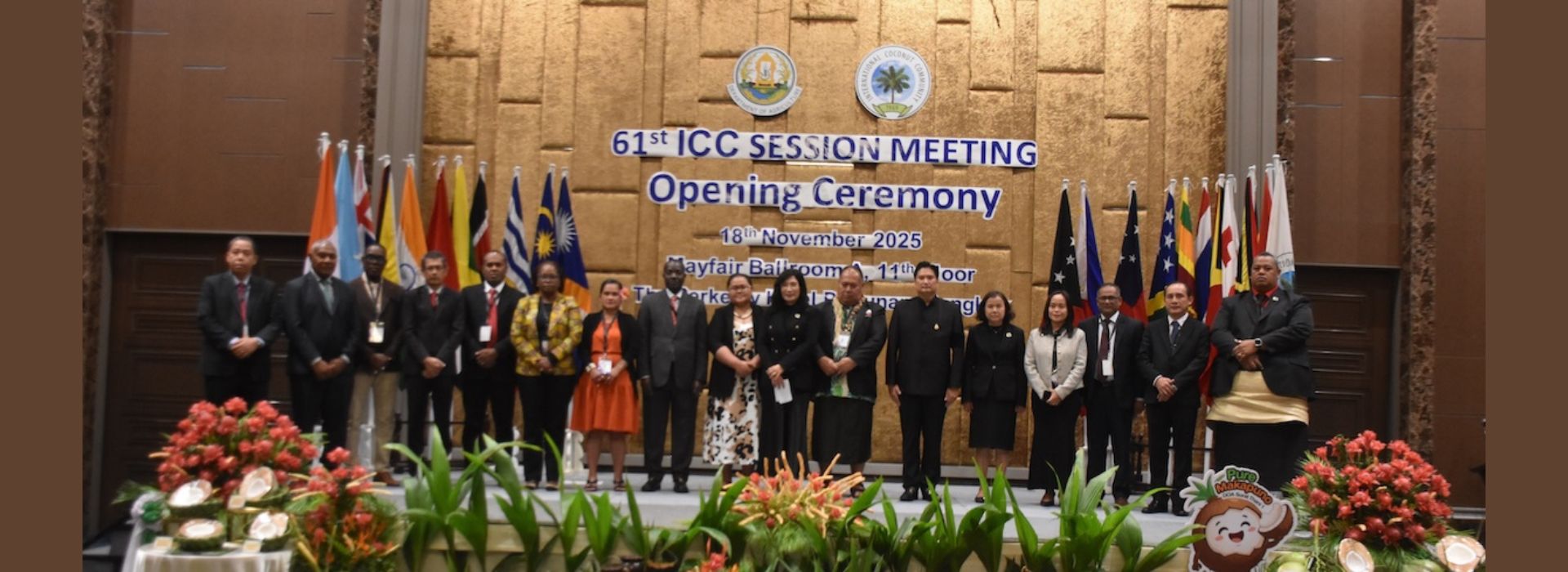
The three-day 61st ICC Session Meeting was conducted at the Berkeley Hotel, Bangkok, Thailand, from 18 to 21 November 2025. The Government of Thailand held the Chair of the International Coconut Community (ICC) for the Current Year 2024-2025, and the Government of Thailand through Department of Agriculture was the host for the 61st ICC Session Meeting.
The first-day agenda of the Session was the Inauguration/Opening Ceremony, wherein Mr. Rapibhat Chandarasrivongs, Director General, Department of Agriculture, Government of Thailand, and Chairman of 61st ICC Session Meeting, delivered the welcome remarks. He warmly welcomed dignitaries and delegates, emphasizing the event's importance as a platform to exchange experience and advance sustainable practices in the global coconut industry. Highlighting coconut’s role as both an economic crop and a symbol of livelihood and culture for millions, the speaker reaffirmed Thailand’s commitment to sustainable sector development, climate adaptation, and technology transfer. Calling for deeper collaboration and knowledge-sharing among member countries, the address concluded with gratitude to all contributors, expressing hopes for a productive, memorable meeting and a resilient future for the coconut sector.

Furthermore, Dr. Jelfina C. Alouw, Director General, ICC delivered the introductory remarks. In her address she extended condolences following the passing of a National Liaison Officer from the Federated States of Micronesia (FSM) and acknowledged the solemn mourning period observed by the Royal Thai Government.
She emphasized that the ICC Session's critical role as the paramount forum for shaping the policy trajectory of the coconut industry. Coconut is hailed as a vital, multi-functional resource, providing solutions from health and wellness to advanced materials and even Sustainable Aviation Fuel (SAF).
Crucially, the DG highlighted the "stark and exciting paradox": despite global demand for coconut products constantly surging, the sector is increasingly unable to meet it due to a lack of stable and cost-competitive raw material supply, compounded by tariff barriers. She urged delegates to move beyond conventional policy and define new strategies over the coming days, focusing on technological transformation, human capital development, fiscal incentives, and the removal of export barriers. The address concluded with a call to action based on the wisdom of Thomas Jefferson: “Agriculture is our wisest pursuit, because it will in the end contribute most to real wealth, good morals, and happiness.”


 Special remarks was delivered by H.E. Elina Akinaga, Secretary, Department of Resources & Development, Federated States of Micronesia. She appreciated to the participants and organizers, especially the ICC Secretariat and the Government of Thailand, emphasizing the coconut’s vital role in Micronesia’s heritage, livelihoods, and cultural identity, the speaker highlighted the importance of the ICC as a platform for partnership, technical guidance, and shared ambition. The speech reaffirmed Micronesia’s commitment to innovation, sustainability, and equitable growth in the coconut sector, underscoring the value of global cooperation for prosperity. The address closed with gratitude and hope for fruitful collaboration.
H.E. Malava Fuimaono Tito Asafo, Minister of Agriculture and Fisheries, Samoa highlighted coconut’s role in Samoa’s culture, economy, and resilience to climate change. Key priorities include replanting old trees with resilient varieties, improving market access, supporting research and technology, and strengthening farmer support. Emphasis is placed on eradicating coconut rhinoceros beetles, fostering international cooperation, and supporting farmers for sustainable, high-value coconut production in the face of ongoing climate and market challenges.

The official opening remarks of the session is done by H. E. Amin Mayusoh, Deputy Minister of Agriculture and Cooperatives, Government of Thailand. He highlighted the coconut industry’s crucial role in the economy and food security. The speech emphasized Thailand’s ongoing commitment to sustainable development through advancing agricultural innovation, increasing farmer income, promoting market-driven policies, and fostering climate-resilient coconut varieties. Technological advancements such as bio-pesticides and value-adding processes were noted. His Excellency also expressed gratitude to ICC member countries and stakeholders, voicing confidence in collective progress towards sustainability and prosperity for the global coconut sector.
Country Statement Agenda

After the Opening Ceremony, one of the most important agendas of the Session meeting was the country statement/paper presentation by member countries to give a brief update on the policies and programs for coconut development undertaken by national governments including the legislation to promote the development of the sector. The delegates presented the statements by Plenipotentiary Delegates, which detailed their national coconut development agendas, covering a wide range of topics from policies, replanting efforts, production statistics, market trends, and trade performance to climate resilience, youth engagement, investment opportunities, and germplasm regulations.

The country papers contributed to a better understanding of the nations' developmental initiatives and the identification of replicable models for adapted implementation in other countries. It also facilitated the exchange of ideas and technology, paving the path for future collaborations between member countries, the ICC, and international partner organizations. Countries presented on the first day were: Coute d’Ivoire, Federal States of Micronesia, Fiji, India, Indonesia, Jamaica, Kenya, Malaysia, and PNG.
During the Opening Ceremony, were also presented ICC Plaque awards to Pioneer Coconut Breeder/Scientist, Best Coconut Farmers, Best Coconut Processing Industry. The Plague awardees were:
- Best Scientist: Mr. Anupap Thirakul, Department of Agriculture, Thailand
- Best Scientist: Mr. Somchai Watanayothin, Department of Agriculture, Thailand
- Best Farmer/Entrepreneur: Mr. Boonprasert Saapma, Thailand
- Best Coconut Based Product Manufacturer: Theppadungporn Coconut Co., Ltd., Bangkok, Thailand

The Inauguration was closed by a joint statement by the ICC member countries on Advancing Standards and Innovation for a Sustainable Global Coconut Industry.