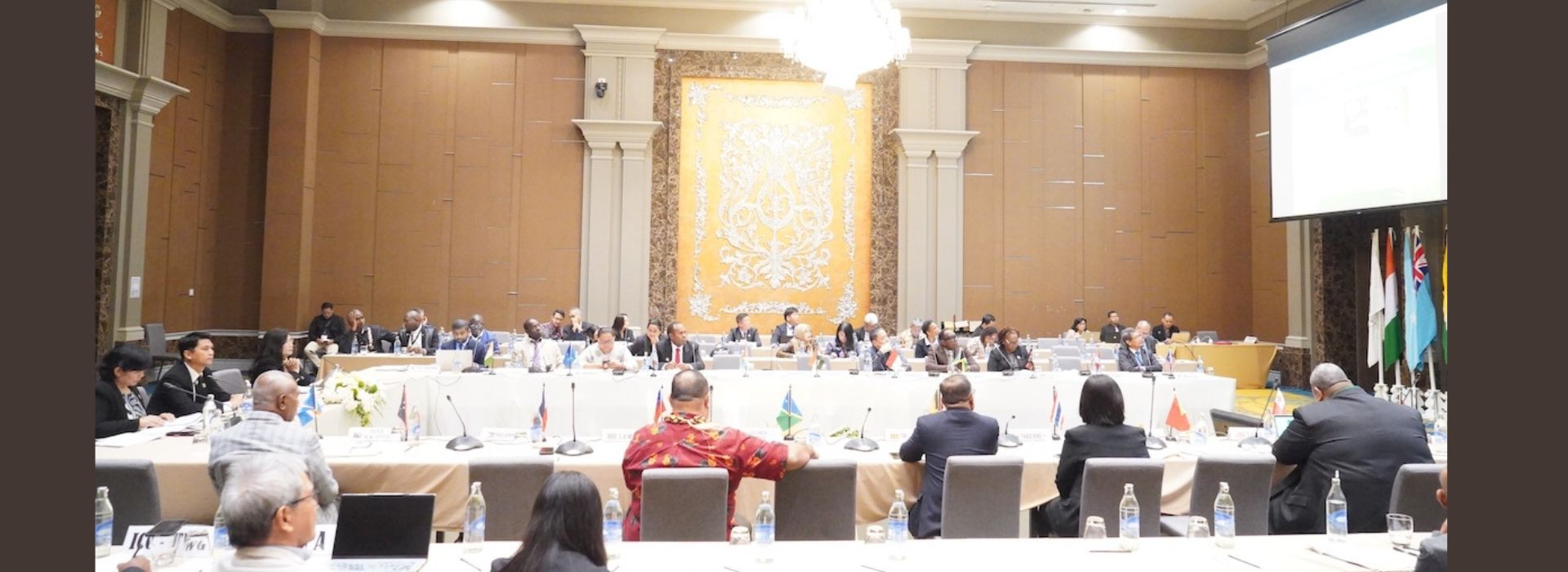
The Session Meeting continued with the Country Statements presentation by Plenipotentiary Delegates from The Philippines, Sri Lanka, Tonga, Thailand, and Vietnam, consecutively. The country papers helped in understanding the developmental work undertaken by countries and identifying the replicable models for customized implementation in other countries. They helped in the exchange of ideas and technology and paved the way for possible collaborations between member countries.
The second day of the 61st International Coconut Community (ICC) Session moved from identifying crises to proposing radical solutions. During the meeting, some participants strongly suggested or advocated for the ICC member countries to stop competing with each other and instead form a single, unified trading group. The goal of this group would be to gain more power in the global market, allowing them to better control prices and trade terms, especially given the supply deficits.

The Session began with Country Statement presentation from the Philippines, represented by Ms. Ma Odessa M. Pacaul, Department Manager, PCA Corporate Planning Service, Philippine Coconut Authority, Quezon City, Philippines. The Philippine coconut industry, vital to the economy and exports, faces aging palms, typhoon threats, and low productivity. Major revitalization programs—planting, hybridization, fertilization, and farmer support—are underway. Investment in processing and innovation, including biofuels, aims to ensure industry growth, sustainability, and improved livelihoods for millions. She mentioned that the Philippines plan to plant 100 million trees by 2028.
Mr. K.S. Wijayakeerthi, Additional Secretary (Coconut and Allied Crops Development), Ministry of Plantation and Community Infrastructure, represented Sri Lanka, urged ICC nations to stop competing against one another and instead unite to dictate global market prices. "We face a 32% supply deficit," he noted, while revealing Sri Lanka's roadmap to reach $1.5 billion in exports by 2030, driven by their premium "King Coconut" variety. Sri Lanka’s coconut sector seeks growth despite drought, productivity, and resource challenges. National programs target replanting, subsidy, and export expansion. With strong cultural and economic importance, Sri Lanka aims for increased output, global market unity, and sustainable practices, collaborating with ICC nations for innovation, pest control, and shared prosperity. Sri Lanka proposes the creation of a "Unified Global Coconut Block".
Mr. Elisaia Sylvester Ika, Chief Executive Officer, Ministry of Agriculture, Food and Forests, Nuku ‘alofa, Tonga presented Tonga’s coconut industry features significant cultivation but faces aging trees, weak enforcement of replanting, and cyclone threats. Government supports replanting, farmer incentives, and demonstration plots, while promoting sector events, research, and international collaboration to acquire new varieties, boost processing, and ensure industry sustainability amid resource and market challenges.
Dr. Wilaiwan Twhishsri, Director, Academic Division, Holticulture Research Institution, Department of Agriculture, Ministry of Agriculture and Cooperatives, Thailand, presented that Thailand’s coconut industry faces production challenges, market fluctuations, shortage of raw materials and climate change impacts on production. Government policies target innovation, export growth, sustainability, and farm certification. Efforts include research, hybrid seedlings, training, and technology adoption. Export volumes, mainly to the USA and China, grow, while ongoing collaboration and adaptation aim to ensure sector competitiveness and resilience. Thailand is developing new varieties like Makar Bruno. The discussion also covered certification programs, farm management techniques, and efforts to improve yield and productivity through technology and collaboration were emphasized.


In his presentation, Mr. Cao Ba Dang Khoa, General Secretary, Vietnam Coconut Association, Ministry of Industry and Trade, Ho Chi Minh City, highlighted significant industry growth for the 2023–2025 period. The sector generated over $1.08 billion in export value in 2024, reaching more than 90 countries. Recent trends include a 20% increase in new plantings to rejuvenate tree age and a strategic shift toward organic fertilization for pest management. Processing enterprise especially food and beverage products contributing the largest share (43%) of export turnover.
Dr. Fabian Dayrit, Emeritus Professor, Ateneo de Manila University, Chairman, Scientific Advisory Committee for Health (SACH), ICC, discussed a comprehensive plan for coconut development from 2014 to 2036. Short-term goals include addressing misinformation about coconut fatty acids and increasing social media campaigns. Medium-term goals aim to establish a new paradigm of coconut oil and heart disease, conduct clinical trials on coconut products like coco sugar, and promote a tropical diet.
Dr. Prabhath Kumar, Chairman, ICC Technical Working Group (TWG), highlighted priorities for sustainable coconut development: strengthening planting material, climate resilience, biosecurity, and youth empowerment. He emphasized aligning with global agendas, creating project proposals to secure external funding, fostering international research collaboration, and strengthening technical advisory roles to develop impactful projects benefiting farmers and coconut stakeholders globally.
Observer Organizations
The observer organization participated in the Session, consecutively presented, were Non-Aligned Movement Centre for South-South Technical Cooperation (NAM-CSSTC), Philippine Council for Agriculture, Aquatic, and Natural Resources Research and Development (DOST-PCAARRD), French Agricultural Research Centre for International Development (CIRAD), Green Power Development Corporation of Japan (GPDJ), Australian Centre for International Agricultural Research (ACIAR), Brazillian Agricultural Research Corporation (EMBRAPA), and Sustainable Coconut Partnership (SCP). The representatives of the organizations presented statements on their activities, their involvement, potential programs and projects for the development of the coconut sector to be implemented in the member countries with the collaboration of ICC.