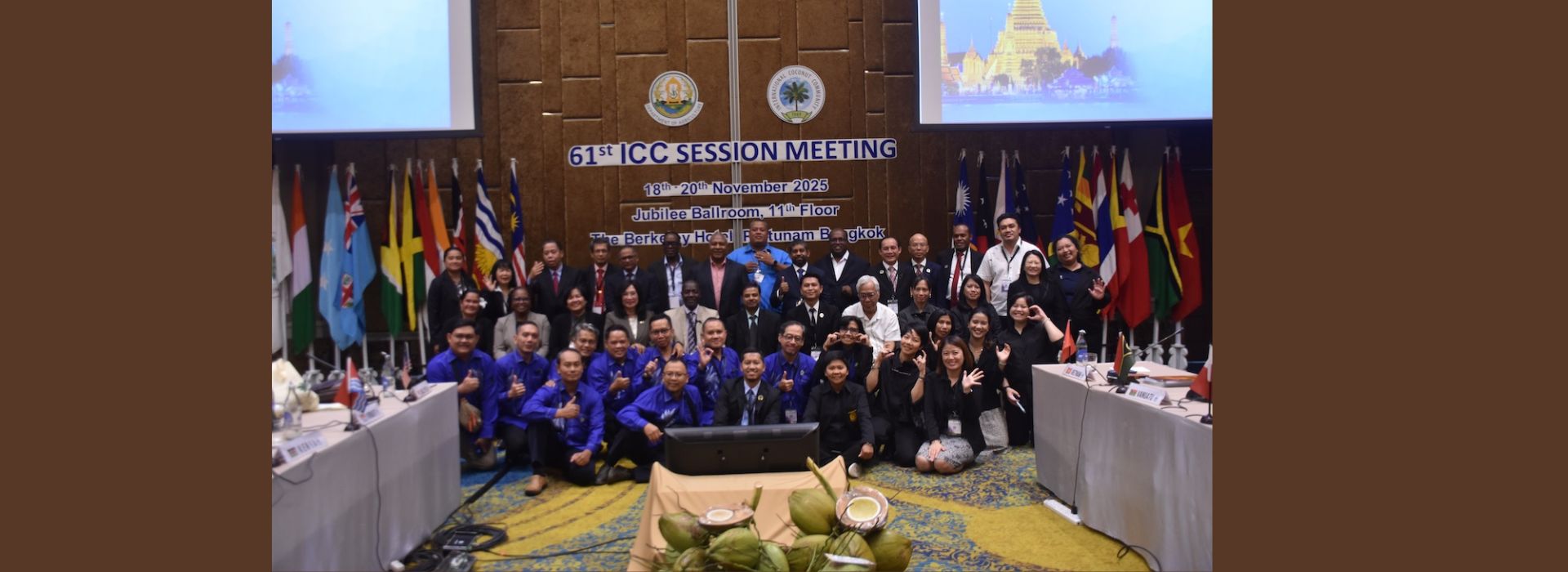
The third day of the 61st Session Meeting of the International Coconut Community (ICC) in Bangkok, Thailand, on Thursday, November 20, 2025, focused on the ratification of critical institutional reforms, the review of strategic activities, and the setting of policy directions for 2026. Delegates approved significant measures aimed at enhancing the efficiency and strengthening the resilience of the global coconut industry.
Strengthened Governance for ICC COGENT & Biosecurity Protocols
The Session ratified a major governance shift within the International Coconut Genetic Resources Network (ICC COGENT). Mr. A. H. Nuwan Chinthaka, ICC Deputy Director General, presented the strategic update, announcing that COGENT’s coordination is now fully placed under the ICC Secretariat through a newly endorsed Standard Operating Procedure (SOP). The report highlighted 2024–2025 achievements, including the handover of the Southeast Asia Genebank and the implementation of climate resilience workshops. To address funding and biosecurity challenges, COGENT plans to implement a unified biosecurity protocol for germplasm exchange, harmonize tissue culture technologies among member countries, launch the COCODIV molecular characterization project, and commence a data modernization initiative using the Genesys software.

Country Statements: Focus on Resilience & Market Access
In continuance with the 2nd Day Session Meeting, one the 3rd Day Agendas was the Country Statement, wherein plenipotentiary delegates presented key updates from their respective nations, highlighting both successes and challenges in their domestic coconut sectors.

Mr. Tanu J. Toomata, Assistant CEO, Crops Division, Ministry of Agriculture and Fisheries, Samoa reported significant progress in farmer cooperative revitalization and value-added processing, specifically noting the expansion of virgin coconut oil (VCO) production for export. Their statement emphasized the urgent need for technical assistance from the ICC to address the escalating threat of the Coconut Rhinoceros Beetle (CRB) variant, Guam Biotype, which is severely impacting young tree stock and threatening long-term productivity goals.

Mr. Cornelius Donga, Deputy Secretary Technical, Ministry of Commerce, Industries, Labour and Immigration, Honiara, Solomon Islands focused on the critical role of coconut production in their national economy and rural livelihoods. The report detailed government initiatives to support smallholder farmers through replanting programs and access to better drying technologies. However, the delegate stressed the challenge of logistics and infrastructure, requesting ICC support to help create more direct market linkages and investment in inter-island transportation to reduce post-harvest losses and improve global competitiveness.
Annual Report & Key Programs for 2026 Approved
The other main agenda was the ICC Annual Report 2024, presented by Dr. Jelfina C. Alouw, General Director, ICC which included the Global Scenario of a Sustainable and Resilient Coconut Sector, highlights of 2024, and update of activities of 2025. For the first time in the Session’s history, the Report was presented in the format of video. The Session also discussed the various programs and projects proposed to be undertaken by ICC during CY 2026.

In the report, one of the key highlight activities in 2024 was the 51st International COCOTECH Conference in Surabaya, Indonesia, inaugurated by the Indonesian President, His Excellency Mr. Joko Widodo, was attended by the Minister of Trade, Mr. Zulkifli Hasan, with 600 more participants from 31 countries. Also presented other strategic activities, such as the celebration of World Coconut Day 2024 in Papua New Guinea which, underscored the theme “Coconut for a Circular Economy”. The commitment to the future was reinforced through the Youth Empowerment Program (YEP), in collaboration with NAM-CSSTC, which trained the younger generation. International Conference on Coconut 2024, Thailand; Coconut Festival 2024, India in Coimbatore. This event featured a symposium, exhibition, and awards ceremony, underscoring collaboration within the industry.
The 60th ICC Session and Ministerial Meeting 2024 in Sri Lanka was the pinnacle of our work. Strategic agendas were adopted, including the approval of the leadership title change (Executive Director to Director General), the chairmanship handed over from Sri Lanka to our next host, Thailand, for the 2025-2026. Other ICC’s activities throughout 2025 centred on enhancing productivity, building capacity, and strengthening global partnerships, such as the ICC side event entitled “Harnessing the Potential of Coconut for Food and Energy Security: Sustainable Solutions for a Resilient Future” on April 25, 2025, during the 81st UNESCAP Session of the Commission in Bangkok, followed by a Consultative Meeting and Field Visits on April 26–27 in Ratchaburi, Thailand. The 1st International Cocohealth Conference, in Coimbatore, India; the World Coconut Day 2025 celebration with ICAR-CPCRI in India; participated and supported the World Coconut Day in several countries, such as Sri Lanka, PNG, and Thailand.
Administrative Agenda & Session Conclusion
The Session touched upon several crucial administrative and financial issues, including the audit report for Calendar Year (CY) 2024, the proposed Secretariat budget for CY 2026, and the handling of outstanding membership contributions. Additionally, the session included nominations for the next ICC Director General (term commencing 2027) and the recruitment of a new Secretary for the Secretariat (term commencing October 2026). Amendments to the ICC staff rules and procedures were also approved for operational modernization. The Session concluded with the ceremonial handover of the ICC Chair from Thailand to India, followed by remarks from both the outgoing and incoming Chairs. Plenipotentiary delegates delivered a vote of thanks, and Director General Dr. Alouw provided closing reflections on the accomplishments and future direction of the coconut sector through ICC.
