
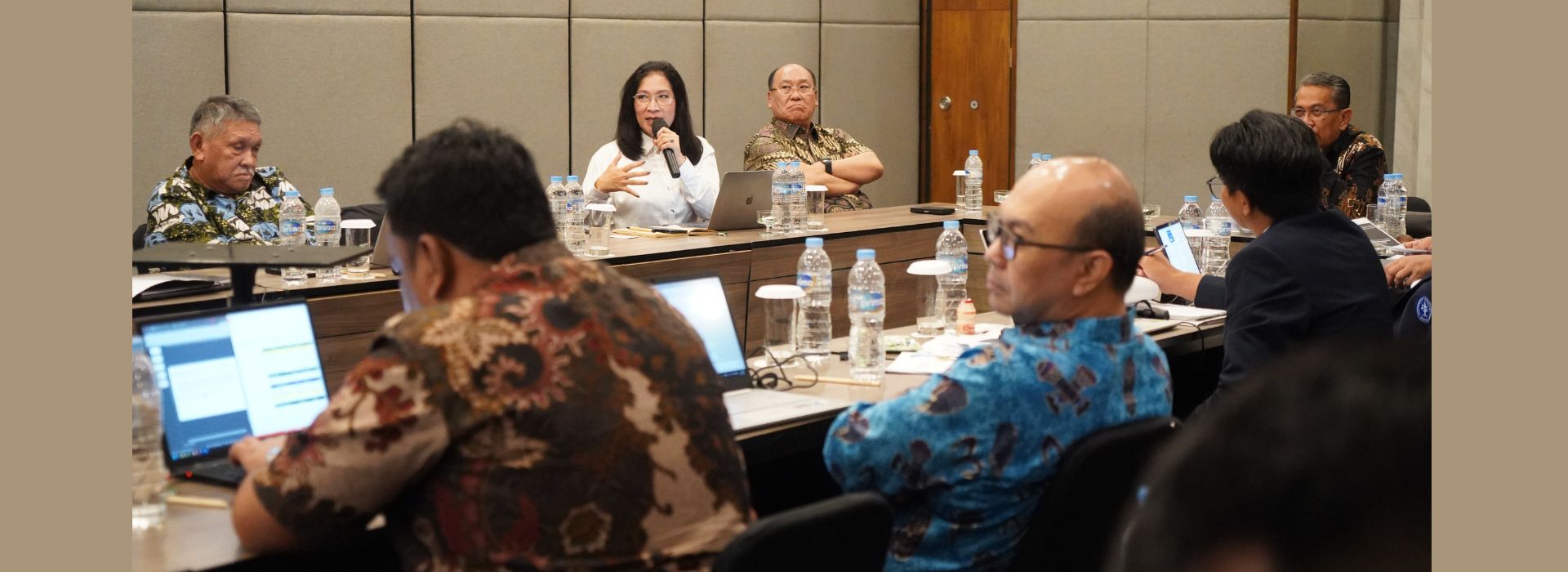
Bogor, 4 December 2025, Director General of the International Coconut Community (ICC), Dr. Ir. Jelfina C. Alouw, delivered a key presentation in Session II of the Coordination Meeting hosted by the Secretariat of the Presidential Advisory Council (Wantimpres), with the central theme: “Agricultural Downstream Investment Strategies to Enhance Farmer Welfare.” The meeting gathered academics, ministry representatives, commodity experts, and policy strategists to strengthen Indonesia’s agricultural downstream development agenda.
Dr. Jelfina underscored the vital role of coconut in regional and global supply chains. Despite increasing global demand, Indonesia’s coconut production has remained stagnant for over a decade. To address this, she stressed that replanting programs must be supported with simultaneous rehabilitation of existing coconut palms. A significant constraint is the insufficiency of national seed availability to meet replanting targets. To overcome this, she advocated for fast-tracking tissue tissue culture technology, which is expected to become commercially viable within the next three years supported by research and technology to optimize the technology. Major coconut-producing provinces Riau, North Sulawesi, East Java, Central Sulawesi, North Maluku and other coconut producing provinces require coordinated support to restore productivity.

The ICC DG promoted polyculture as a crucial strategy for environemtal resilience and food security. Given the typical 8-9 meter spacing between coconut palms, complementary crops can be integrated, improving income stability, strengthening household food security and maximizes overall land productivity and enhancing ecosystem stability. This approach positioned coconut as a crop with exceptional ecological and economic flexibility.
Dr. Jelfina also highlighted a range of downstream coconut sectors with strong investment potential: coconut shell charcoal and activated carbon (essential for European industries and reducing pressure on natural forests), husk-based products like coir fiber and peat substitutes, and the continued growth of coconut oil exports and oleochemical derivatives. A notable new opportunity is in Sustainable Aviation Fuel (SAF) feedstock, citing a Japanese investor who established a facility in South Sumatra to convert coconut oil (CNO) for export to Japan. Furthermore, drawing on evidence from the studies conducted by a research institute in the Philippines, the DG explained that incorporating coconut milk into school feeding programs can significantly reduce stunting, an insight highly relevant for nutrition and human-capital policies. This approach also holds potential for integration into Indonesia’s MBG program, offering a practical, locally sourced solution to improve child nutrition outcomes.
To ensure downstream benefits reach farmers, she stressed the importance of minimum price mechanisms, professionalizing farmers through capacity development, and strengthening value chain management, including nurseries, logistics, and quality standards. She warned that downstream expansion without strong upstream foundations may harm producers, mirroring the experience of other commodities that lost competitiveness. This caution was reinforced by insights from other commodity sector.

Dr. Purwono presented data showing that Indonesia’s white crystal sugar production remains strong, with declining household consumption eliminating the need for additional imports in 2025. He noted that Indonesia is already considered self-sufficient under FAO standards, reinforcing the importance of prioritizing domestic productivity improvements rather than relying on external supply.
From the cassava sector, Dr. H. Welly Soegiono highlighted how recent regulations unintentionally pushed tapioca prices below cassava prices while triggering higher import volumes, disrupting what had previously been a naturally aligned market. He cautioned that even well-intentioned policies can harm farmers if not carefully calibrated, drawing parallels to the decline of Lampung’s once-dominant pepper industry. These examples underscore the relevance of Dr. Jelfina’s call for downstream strategies that strengthen, rather than destabilize, farmer livelihoods.
The Wantimpres Secretariat highlighted that agricultural downstreaming carries strong multiplier effects, including: Improved farmer incomes, Expanded employment opportunities, Strengthened local economies. However, several constraints remain significant: Suboptimal downstream ecosystems, Underdeveloped infrastructure and logistics, Inadequate quality standards and traceability systems, Input subsidy inefficiencies, Limited raw material supply for key commodities-particularly coconut. The coconut sector exemplifies the need to synchronize upstream improvements with downstream industrialization, ensuring long-term sustainability and competitiveness.

To support Indonesia’s downstream acceleration agenda, Dr. Jelfina outlined several priority recommendations: A National Coconut Revitalization Roadmap combining replanting, rehabilitation, nursery expansion, and tissue-culture acceleration. Strengthened pricing policies and farmer professionalization initiatives ensuring equitable value distribution. Cluster-based development for coconut industries to reduce logistics costs and stabilize raw material supply. Promotion of high-value added products. International collaboration and foreign investment partnerships to support technology transfer and diversification of market demand.
These actions aim to unlock the estimated IDR 164 trillion (USD ~10.5 - 11 billion) value-added potential from Indonesia’s coconut sector significantly higher if advanced derivatives scale commercially.
The discussions provided a comprehensive and forward-looking perspective on strengthening Indonesia's coconut sector as a cornerstone of national downstream transformation. This direction, championed by Dr. Jelfina, emphasized a balanced approach that is vital for inclusivity. The ICC DG's call to synchronize upstream productivity (benefiting farmers and input suppliers), downstream innovation (engaging industry and investors), and farmer protection (ensuring equitable value distribution) resonated deeply, confirming the necessity of integrated strategies that benefit all stakeholders across the value chain—from smallholders to large processors and international markets.
The insights from coconut, sugar, and cassava experts collectively reinforced the importance of integrated investment strategies that enhance national competitiveness while ensuring sustainable prosperity for Indonesia’s farmers.