Yogyakarta, Indonesia 10–11 October 2025
A pioneering partnership lights the path for elite variety coconut propagation, connecting global science, national vision, and private innovation to drive Indonesia’s 2030 coconut revitalization roadmap.
A new milestone in Indonesia’s agricultural innovation was achieved as the Ministry of National Development Planning (BAPPENAS), the International Coconut Community (ICC), and Bambu Nusa Verde joined forces to strengthen the nation’s capacity in coconut tissue culture research and development.
Through a policy discussion and laboratory visit held at BPTH Wilayah III Yogyakarta and Bambu Nusa Verde, participants explored how science, government, and industry can collaborate to ensure a sustainable and resilient future for Indonesia’s most versatile crop, the coconut.
A United Effort with Global Expertise
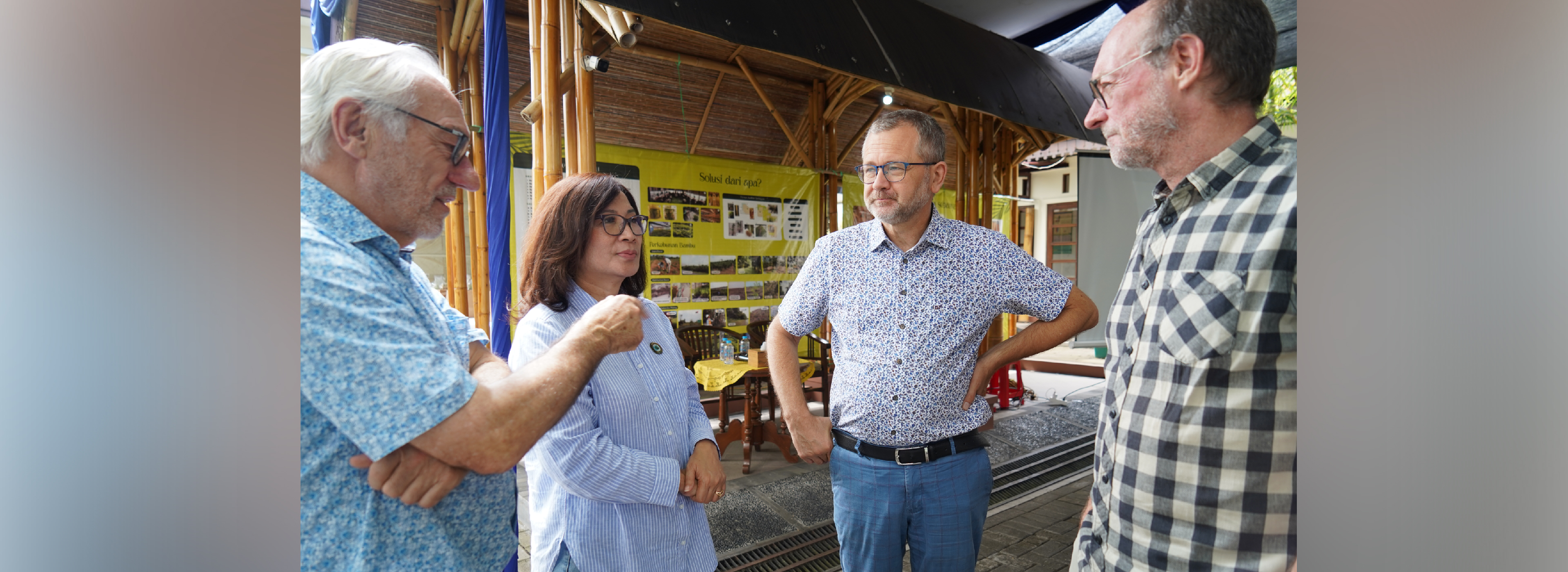
Representing Bambu Nusa Verde, Mr. Marc Peeters (Director) and Mr. Jan Oprins (Commissions) led discussions with Mr. Donatus Gede Sabon (Secretary General, HIPKI), Mrs. Yohana, and Mrs. Novela.
The program was enriched by two world renowned scientists Dr. Bartholomeus (Bart) Panis of Alliance Bioversity International CIAT, KU Leuven (Belgium) and Prof. Stefaan P.O. Werbrouck of Ghent University, whose contributions brought global insight and scientific rigor to the initiative.
Government representatives from Bappenas, BRIN, and BRMP joined the dialogue, confirming national commitment to accelerate biotechnology based replanting and seed improvement programs.


Innovation in Action at Bambu Nusa Verde
At its Yogyakarta facility, Bambu Nusa Verde presented two promising approaches for coconut micropropagation:
COAXIM (Coconut Axillary Meristems), a breakthrough clonal technique that eliminates the callus phase and enhances genetic stability, and
Somatic Embryogenesis (SE), a complementary embryo based method for large scale multiplication.
The team demonstrated consistent progress in tackling early stage challenges such as embryo browning and contamination. Through careful control of light exposure and the use of activated charcoal, researchers are refining culture protocols to improve embryo survival.
Since March 2025, Bambu Nusa Verde has been perfecting its standard operating procedures through persistent experimentation, a process now strengthened by the direct mentorship of Dr. Bart Panis, who personally evaluated their techniques and provided detailed feedback for optimization.
The lab has successfully processed 123 explants, with roughly 80 via the COAXIM method, and is now developing standardized fruit selection criteria based on maturity, size, weight, water volume, and mesocarp thickness, laying the groundwork for a scalable elite variety propagation system.


Dr. Bart Panis Inspiring Excellence in Tropical Biotechnology
A central highlight of the program was the presentation by Dr. Bart Panis, whose pioneering work in plant cryopreservation and tropical crop tissue culture has reshaped how the world conserves and multiplies valuable genetic resources.
At KU Leuven, Dr. Panis oversees one of the world’s largest in vitro banana collections, a crop feeding over 400 million people, with more than 1,600 active in vitro accessions, 939 lyophilized leaf samples, and 1,195 cryopreserved accessions. His work ensures that clean, disease free plant materials can be distributed safely and efficiently across more than 120 countries.
Introducing COAXIM (Coconut Axillary Meristem Culture), Dr. Panis described it as a revolutionary, user friendly protocol that can redefine the future of coconut propagation worldwide. The method:
- Enables true to type clonal propagation of elite trees.
- Allows mass multiplication to meet market demand.
- Reduces the risk of somaclonal variation by avoiding a callus phase.
- Can be adopted in standard tissue culture laboratories.
- Supports long term genetic conservation through cryopreservation.
Dr. Panis traced the protocol’s origins to collaborative research with Bioversity International and the RDA Cryo Genebank in Legazpi, Philippines, emphasizing that its success reflects years of persistence and global cooperation.
He reminded participants that tissue culture is not only about technique; it requires careful long term planning and sustained investment to ensure lasting success and impact.
His insights and mentorship inspired participants, including Dr. Jelfina C. Alouw, who praised his visit as “a turning point that strengthens Indonesia’s confidence to lead in tropical crop innovation.”
Prof. Stefaan Werbrouck Advancing Plant Science For a Sustainable Future
Prof. Stefaan P.O. Werbrouck, a leading figure in plant biotechnology and in vitro research from Ghent University, complemented Dr. Panis’s applied approach with a strong academic perspective. He presented the university’s research focus on micropropagation, in vitro breeding, plant health, and secondary metabolite production, underscoring the vital role of clean, pathogen free plant material for sustainable agriculture.
Prof. Werbrouck emphasized that tissue culture innovation is not confined to elite laboratories; it can thrive wherever scientific curiosity and dedication meet. He shared inspiring examples of graduate research from Indonesia, Tunisia, Azerbaijan, Iran, Uganda, and Belgium, covering crops such as cocoa, chili, pistachio, spinach, and coffee, each exploring advanced techniques in fungal and viral detection, culture optimization, and metabolite profiling.
He also highlighted the importance of bridging academic research with private sector initiatives, such as Bambu Nusa Verde’s, to ensure that innovation transitions from theory to practice. His message resonated deeply with participants:
“Knowledge has no borders. When shared, it becomes the seed of transformation for all.”
Aligning Science with National Priorities
In her remarks, Dr. Jelfina C. Alouw, ICC Director General, reaffirmed the organization’s commitment to help Indonesia prioritize elite coconut varieties and align scientific efforts with the country’s 2030 replanting roadmap. She emphasized that biotechnology is the cornerstone of achieving the nation’s ambitious goal of 500,000 hectares of coconut replanting by 2030.
“This collaboration represents the synergy we need, where science meets policy and innovation meets national purpose,” said Dr. Alouw.
“We are proud to see Bambu Nusa Verde’s initiative supported by outstanding scientists such as Dr. Bart Panis and Prof. Stefaan Werbrouck. Together, we are shaping a more resilient and productive coconut sector for Indonesia and beyond.”
She also thanked Mr. Donatus Gede Sabon for initiating the engagement, and Mr. Marc Peeters and Mr. Jan Oprins for their commitment and investment in research and capacity building.
Bambu Nusa Verde expressed deep appreciation to ICC for bridging connections with international coconut research networks, a crucial step for scaling innovation beyond the private sector.
A New Dawn for Indonesia’s Coconut Future
The Yogyakarta collaboration has proven that science, policy, and industry can unite to drive real transformation. With Dr. Bart Panis’s visionary guidance, Prof. Werbrouck’s academic partnership, Bambu Nusa Verde’s dedication, government supports, coconut association participation, and Dr. Jelfina Alouw’s leadership, Indonesia is charting a bold course toward becoming a regional leader in coconut biotechnology.
This partnership stands as a living example of what persistence and collaboration can achieve, transforming the coconut from a traditional commodity into a symbol of scientific progress, sustainability, and national and international pride.
