
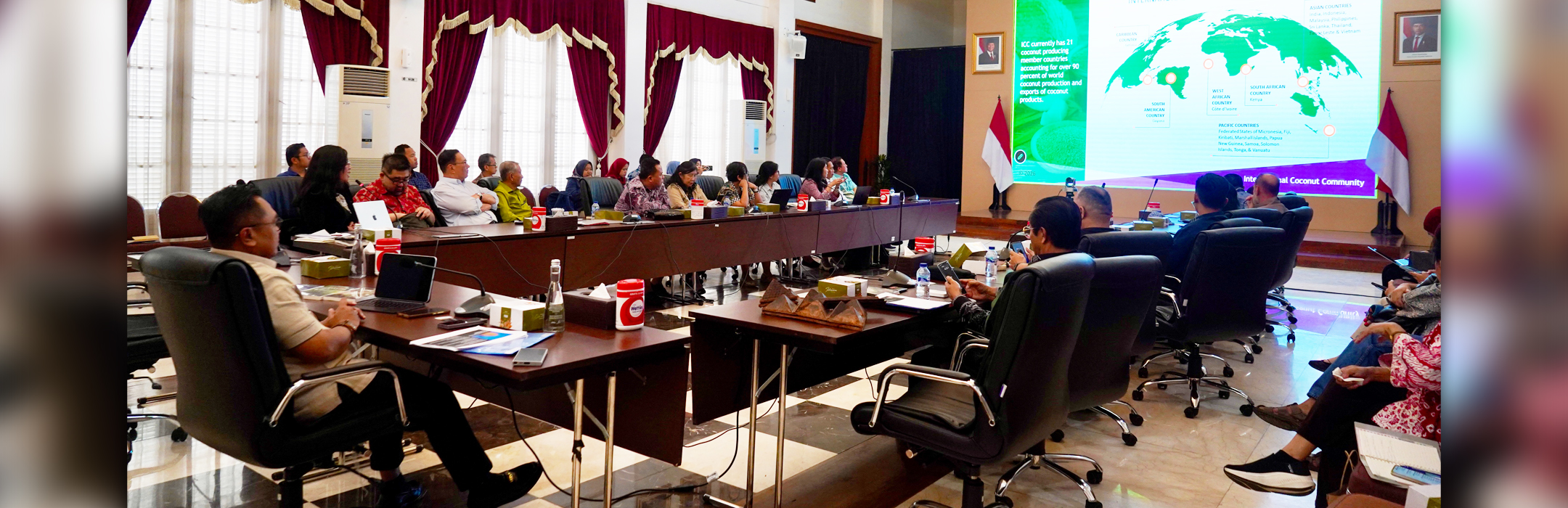
Stakeholders from government institutions, industry associations, businesses, and the international coconut sector gathered at the Ministry of National Development Planning (BAPPENAS) on Wednesday, June 3rd 2026. The meeting aimed to gather aspirations and recommendations from stakeholders across Indonesia’s coconut sector to support efforts to accelerate downstream processing and increase the value-added contribution of coconut products to the national economy. The International Coconut Community was involved to share their role in accelerating coconut downstream development in Indonesia.

The discussion was led by Mr. Sukmo Harsono, Special Advisor to the Minister of National Development Planning, and attended by Dr. Jelfina C. Alouw, Director General of the International Coconut Community (ICC); Ms. Nina Damajanti, Trade Negotiator at the Ministry of Trade; Mr. Tay Enoku, President Director of Sambu Group & chairman of the Indonesian Coconut Processing Industry Association (HIPKI); Ms. Tari Surardjo, Director of PT. Cocona; Mr. Asep Jembar Mulyana, Director of House of Charcoal; Dr. Har Adi Basri, General Secretary of the Indonesian Coconut Board; Dr. Dian Novita Susanto, Chairwoman of Perempuan Tani HKTI; and Dr. Petrus Gunarso, Leader of the Tropical Palm Book for the World drafting team.
During the session, Dr. Jelfina as a Director General of ICC presented the organization’s strategic outlook on the global coconut industry. She highlighted the growing international demand for value-added coconut products and discussed key challenges facing both Indonesia and coconut-producing countries worldwide.

Dr. Jelfina also highlighted innovations implemented by other countries that could serve as valuable benchmarks for Indonesia’s coconut downstream development agenda. She cited China’s efforts to build an extensive nationwide distribution network comprising commodity wholesale markets, cold-chain logistics facilities, and thousands of rural e-commerce service centers under the China E-Coop system. Furthermore, China has also established integrated coconut museums that allow visitors to observe the entire coconut value chain, from raw material processing into ready-to-sell products, while providing opportunities to purchase that products directly on-site.
She further pointed to Thailand’s advancement in multi-omics technologies, which have enabled the development of new “elite” coconut varieties with enhanced commercial value called “White Cloud”, a hybrid combining Aromatic variety, which has the fragrant water, with a sweet kernel of Macapuno variety.
In her presentation, Dr. Jelfina emphasized that the International Coconut Community (ICC) has undertaken a range of strategic interventions to support member countries. These include promoting the optimization and adoption of micropropagation technology, facilitating technology transfer, encouraging the utilization of coconut by-products and co-products, strengthening product competitiveness and market access through international quality standards, advancing global advocacy and capacity-building initiatives, and countering negative perceptions and misinformation surrounding coconut products, particularly coconut oil.
In a separate presentation, Dr. Petrus Gunarso delivered insights on “Accelerating Indonesia’s Coconut Downstream Industry: National and Global Policy Perspectives.” He emphasized the importance of aligning domestic policies with global market developments to strengthen Indonesia’s position in the international coconut industry.

The discussion also provided an opportunity for business representatives and industry stakeholders to convey recommendations and concerns directly to BAPPENAS. Participants shared perspectives on challenges and opportunities across the coconut value chain, with a focus on improving productivity, expanding market access, enhancing technology adoption, and increasing value-added processing. Notably, representatives from the Indonesian Coconut Entrepreneurs Association (HIPKI) highlighted a pressing structural priority. They noted that while downstream processing (hilirisasi) is already being successfully advanced by the industrial sector, the upstream supply chain remains vulnerable. To ensure long-term sustainability, HIPKI emphasized the critical importance of actively engaging smallholder farmers in the collaborative establishment of certified seed gardens. They urged the government to implement a robust regulatory framework governing seed standardization and quality control. Ultimately, to protect and sustain the domestic coconut industry, a systemic approach is required—one that secures the supply of high-yielding planting materials while safeguarding national industrial competitiveness.


The meeting reflected a growing commitment among government agencies, industry players, and international partners to strengthen Indonesia’s coconut sector and accelerate the development of a more competitive and sustainable downstream industry.