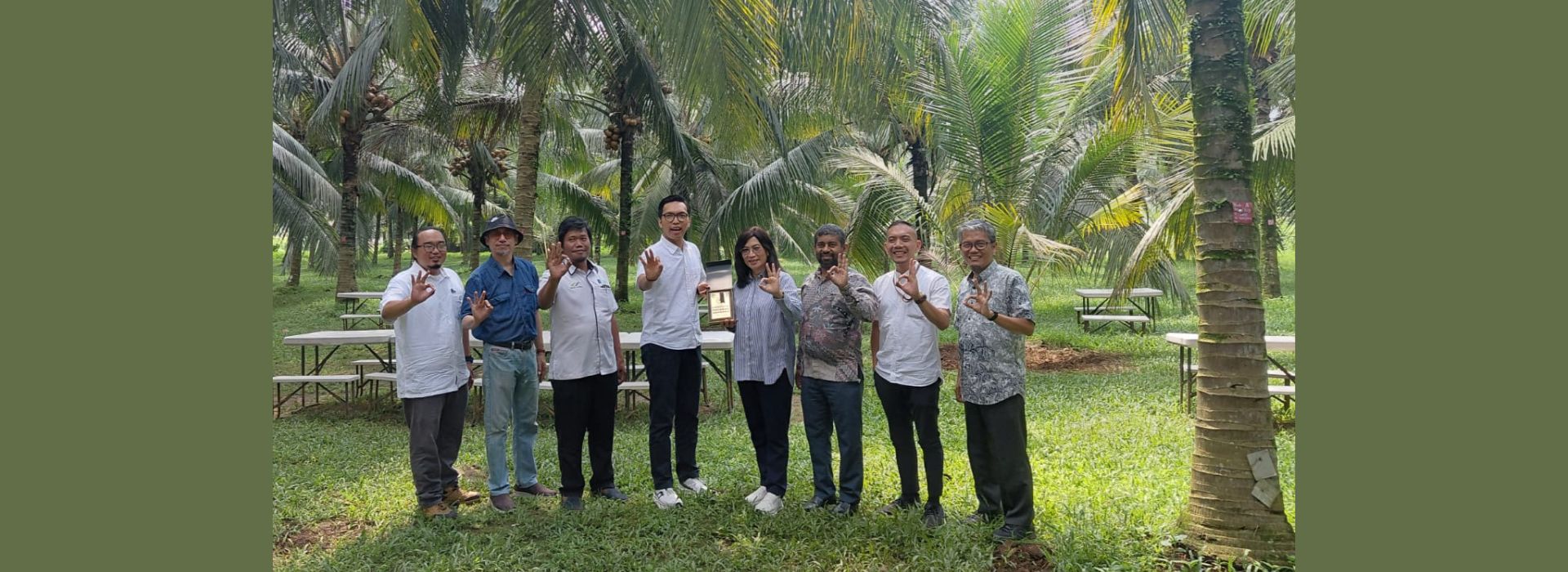
A high-level delegation from the International Coconut Community (ICC) Secretariat, alongside representatives from Papua New Guinea (PNG), conducted an official visit to the Indonesian Oil Palm Research Institute (IOPRI) experimental garden in Ciomas, Bogor, on 11 May 2026. The visit aimed to foster knowledge exchange, promote capacity building, and explore innovative coconut-based agro-tourism and micro-propagation techniques.
This visit was part of a comprehensive technical exposure program facilitated by the ICC in response to an official request from the Kokonas Indastri Koporesen (KIK) of Papua New Guinea. The technical program, which spans from May 8 to 19, 2026, was specifically designed to strengthen international cooperation and capacity building. Representing the KIK in this mission were Mr. Alfred Kembu and Mr. Michael Molly Kevin. Under the facilitation of the ICC, the primary objective for the KIK officers is to engage in an in-depth study of value-added coconut products, which is seen as a vital pillar for the industry's growth in Papua New Guinea.

The delegation was warmly welcomed by IOPRI Deputy Head, Dr. Riza Arief Putranto, D.E.A., alongside senior researcher Dr. Imron Rosyadi and their colleagues. Leading the visiting delegation was the ICC Director general, Dr. Jelfina C. Alouw, who was accompanied by the Deputy Director General, Mr. Aluthhewa Nuwan Chinthaka, and ICC Secretariat staffs. ICC directors in attendance included Mr. Alit Pirmansah (Director of Market & Statistics), Mr. Klaudio D. Hosang (Admin & Finance Director), Mr. Otniel Sintoro (Information & Publication Director).
Exploring Kopyor Cultivation & Agro-Tourism
In her opening remarks, Dr. Jelfina C. Alouw highlighted the strategic importance of the visit as a platform for the ICC team to observe firsthand the advancements in coconut-based agro-tourism and coconut kopyor’s embryo culture development. She expressed her vision for these innovations to be adapted and replicated across ICC member countries, particularly in the Pacific region, to bolster economic development. Dr. Alouw also extended her appreciation to IOPRI for prioritizing coconut research alongside its oil palm initiatives, noting that such dedication is vital for the livelihoods of millions of farmers within the community. “This visit is a great opportunity for our team to directly observe coconut-based agro-tourism and in-vitro coconut kopyor development, and to explore how these innovations can be adopted and replicated across ICC member countries,” emphasized Dr. Jelfina C. Alouw.

During the visit, participants toured the Experimental Garden, Ciomas, Bogor, a facility dedicated to advanced coconut research and cultivation. The delegates learned that the institution manages approximately 58 hectares of coconut experimental gardens, which are strategically distributed between the Ciomas and Cibodas locations. This extensive research ground serves as a vital hub for genetic conservation and technical development.
Information shared during the tour highlighted that research dedicated to high-value Kopyor coconut varieties at this facility has been a long-standing commitment, having been initiated in 1984. Furthermore, since 2024, the Bogor facility has expanded its function into a premier agro-tourism destination. This integration allows the public and local communities to explore the research grounds while enjoying fresh coconuts directly from the field, creating a sustainable business model for research institutions.
Capacity Building & Future Collaborations
The field visit provided a critical capacity-building opportunity for the ICC staff members in attendance, allowing them to witness coconut micro-propagation and embryo culture techniques firsthand. Such technical exposure is essential for the secretariat to better support member countries in modernizing their planting materials. Both parties emphasized the urgent need for research collaboration to tackle pressing global challenges, including climate change, global warming, and the integrated management of pests and diseases.
Furthermore, leaders discussed methods for sustainable land management and strategies to increase the global demand for high-quality coconut products, seeds, and planting materials. The ICC encouraged the exploration and development of unique and aromatic coconut varieties to increase export value, noting successful commercialization models utilized in countries like Thailand as a benchmark.
The Papua New Guinea delegation, representing a nation with significant coconut productivity in the Pacific region, expressed keen interest in adopting these cultivation technologies and agro-tourism business models to enhance their domestic consumption and commercial coconut oil sectors. The event concluded with mutual commitments to strengthen future partnerships between the ICC, PNG, and IOPRI. All representatives expressed their commitment to continued knowledge exchange and interest in organizing future joint events to support the long-term advancement and sustainability of the global coconut industry.