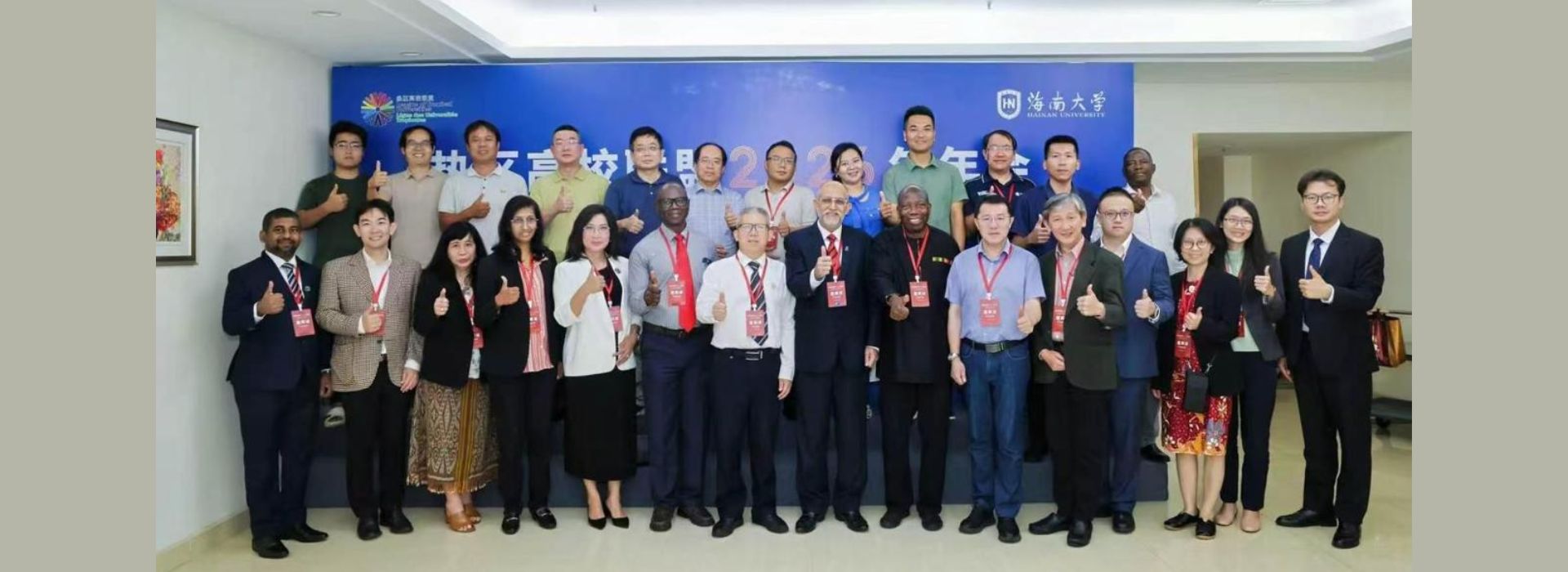
The International Coconut Community (ICC) delegation, led by Director General Dr. Jelfina C. Alouw, accompanied by Deputy Director General Mr. Nuwan Chinthaka, successfully concluded an official visit to Hainan Province, People’s Republic of China, from 18–22 May 2026. The visit was conducted at the invitation of Hainan University and the organizers of the League of Tropical Universities (LTU) 2026 Summit. The mission provided an important platform to strengthen international collaboration, explore strategic opportunities for the global coconut sector, and further connect the Chinese coconut industry with the wider international coconut community.
The visit included high-level discussions with Hainan University, Yazhou Bay Science and Technology City Administration, the Coconut Research Institute of the Chinese Academy of Tropical Agricultural Sciences (CRI-CATAS), coconut industry stakeholders, and cooperative enterprises engaged in tropical agriculture and innovation. The ICC delegation also participated in the LTU 2026 Summit and delivered keynote presentations on global coconut sustainability, governance, research collaboration, and the future strategic direction of the coconut sector.

Strengthening Academic and Scientific Cooperation with Hainan University
The first day of the visit commenced with discussions at the Yazhou Campus of Hainan University in Sanya. The ICC delegation met with Prof. Jie Luo, Chief Scientist of the Hainan Yazhou-Bay Seed Laboratory and School of Breeding and Multiplication of Hainan University. During the meeting, Prof. Luo highlighted that Hainan University has been actively engaged in coconut-related research for more than eight years and has developed advanced technologies and skilled human resources in the field of tropical agriculture, including achievements in coconut tissue culture research.
Prof. Luo expressed Hainan University’s strong interest in strengthening cooperation with ICC and COGENT to support the development of the coconut sector in China and globally. Discussions focused on opportunities for scientific collaboration, germplasm conservation, biotechnology, breeding, and technology exchange. Director General Dr. Alouw encouraged the university to develop collaborative research proposals jointly with ICC and Hainan University to facilitate broader engagement of Chinese scientists with international coconut experts and global research networks.
The meeting also highlighted emerging opportunities related to the use of coconut resources in the bioeconomy sector, including the utilization of non-standard coconuts for biofuel and Sustainable Aviation Fuel (SAF) development. The discussions reflected growing global attention toward coconut as a strategic crop contributing not only to food and livelihood security, but also to climate resilience and renewable energy initiatives. The DG further emphasized the growing relevance of coconut within the global bioeconomy, including recent international developments recognizing non-standard coconut oil as a potential feedstock for SAF production.
Discussions with Yazhou Bay Science and Technology City Administration
A second strategic meeting was conducted at the Nanfan Research Institute of Hainan University with representatives from the Sanya Yazhou Bay Science and Technology City Administration. The meeting focused on introducing the development vision of Yazhou Bay Science and Technology City and identifying potential areas of cooperation between ICC and the administration, particularly in relation to coconut germplasm conservation and international scientific collaboration.
The meeting was attended by senior representatives including the General Secretary of the Hainan Coconut Industry Association Dr. Haiku Fan, the Director of the Intellectual Property & Innovation Cooperation Department, and officials from the Yazhou Bay Science and Technology City Administration. During the discussions, the administration highlighted their ongoing efforts in promoting high-efficiency tropical agriculture and their ambition to establish Sanya as a globally significant center for tropical crop innovation through the Global Seed Industry Innovation Cooperation and Exchange Base.
Both parties discussed the possibility of developing stronger collaboration on global coconut germplasm conservation and explored the long-term feasibility of establishing an International Coconut Genebank in Sanya under the framework of ICC and COGENT cooperation. Discussions also included the possibility of creating platforms for global coconut resource sharing and strengthening international scientific exchange. The importance of conserving coconut genetic diversity was strongly emphasized, considering the growing threats posed by climate change, pests, diseases, and declining coconut productivity globally. ICC’s presentations highlighted the existing international coconut genetic resource network consisting of International Coconut Genebanks and National Coconut Genebanks managed under the ICC-COGENT framework.
Representatives from Yazhou Bay Science and Technology City also invited ICC and its member countries to participate in the Annual Consumer Exhibition in Hainan, which would provide opportunities for coconut industries from ICC member countries to access the rapidly growing Chinese consumer market. They further proposed exchange programs with coconut research centers from ICC member countries to facilitate technology transfer and strengthen cooperation in areas such as pest and disease management, tissue culture, breeding, and sustainable cultivation practices.
During the discussions, Director General Dr. Alouw delivered a presentation titled “Global Scenario of Sustainable Coconut Sector” where she provided a comprehensive overview of the current status of the global coconut industry, ICC’s programs and initiatives, global production trends, market opportunities, and sustainability challenges facing the sector.
The presentation highlighted the global importance of coconut as a “Tree of Life,” its contribution to food security, livelihoods, climate resilience, and renewable energy opportunities. It also emphasized the significant global economic value of coconut products and the growing demand for value-added coconut-based industries.
ICC Participation at the LTU 2026 Summit
On the second day, the ICC delegation attended the League of Tropical Universities (LTU) 2026 Summit held under the theme “Intelligent Connectivity, Shared Future: The Mission and Innovation of Universities in the Digital Era.” The summit brought together distinguished academics, scientists, policymakers, and industry leaders from around the world to discuss the future of tropical agriculture, innovation, and sustainable development.

Director General Dr. Jelfina C. Alouw participated as a distinguished resource speaker at the Parallel Session titled “Sustainable Development and Technological Transformation in the Palm and Tropical Cash Crops Industry.”
During the session, Dr. Alouw delivered a presentation titled “Evidence-Based Governance and Research Excellence: Strategic Roadmaps for Global Coconut Sustainability.” The presentation outlined the strategic role of ICC as an intergovernmental organization and highlighted the importance of evidence-based governance, scientific cooperation, and international collaboration in addressing the major challenges facing the global coconut sector.
The DG emphasized that the coconut industry supports the livelihoods of millions of smallholder farmers worldwide and contributes significantly to food security, trade, health, climate resilience, and sustainable development. The presentation further highlighted the dual mandate of ICC and COGENT in advancing policy advocacy, market linkages, germplasm conservation, genomics, crop protection, and capacity building.
Dr. Alouw also presented recent data and trends demonstrating the growing global economic importance of the coconut industry, including increasing global export values and expanding opportunities in coconut water, virgin coconut oil, coconut shell charcoal, coir products, and renewable energy applications.
Importantly, the presentation addressed major sustainability challenges confronting the coconut sector, including climate change, aging palms, low productivity, pests and diseases, labor shortages, biodiversity loss, and limited access to quality planting materials. The DG stressed the importance of international research collaboration, policy harmonization, scientific innovation, and youth engagement to ensure the long-term sustainability and resilience of the sector.

The session also featured several important presentations related to tropical palm research and coconut development. Among them was a presentation titled “Genomics and Molecular Breeding of Tropical Palms: Unlocking Diversity for Sustainable High-Value Production” by Dr. Siwaret Arikit of Kasetsart University, who currently serves as the leader of ICC-COGENT ITAG 02 on Coconut Genomics and Breeding. Another notable presentation was delivered by Prof. Uma Rani Sinniah of Universiti Putra Malaysia on “Enhancing Coconut Hybrid Seed Production System for a Resilient Coconut Industry.”
The parallel session served as a productive scientific platform for strengthening collaboration among international researchers, universities, and institutions working in tropical agriculture and coconut research.
Visit to the Coconut Research Institute (CRI-CATAS)
On the third day, the ICC delegation visited the Coconut Research Institute (CRI) of the Chinese Academy of Tropical Agricultural Sciences (CATAS), China’s only national-level research institute dedicated to coconut research and development. The delegation was warmly welcomed by Dr. Hu Wei, Director of CRI-CATAS, together with senior researchers and scientists of the institute. The visit provided an opportunity for the ICC delegation to observe firsthand the extensive research facilities, nurseries, and seed gardens maintained by CRI-CATAS and to witness the remarkable scientific work undertaken by the institute.
During the technical discussions, the CRI-CATAS team presented an overview of the institute’s research achievements, scientific innovations, and ongoing programs related to coconut breeding, germplasm conservation, crop management, and biotechnology. According to the institute, CRI-CATAS has currently conserved 214 coconut accessions and successfully bred eight high-yielding coconut varieties, demonstrating significant progress in coconut research and genetic improvement in China. The CRI leadership highly appreciated the work carried out by ICC and COGENT in promoting international cooperation and advancing the global coconut sector. Director General Dr. Alouw delivered another presentation highlighting the current global scenario of the coconut industry, including opportunities and challenges related to production, sustainability, climate resilience, and market development. She also encouraged Chinese scientists and researchers to engage actively with ICC-COGENT International Thematic Action Groups (ITAGs) and share their expertise with the international coconut research community.
Furthermore, the DG invited CRI-CATAS to strengthen collaboration with ICC in areas such as scientific publications, capacity building, technology transfer, and international training programs. The CRI leadership expressed strong willingness to collaborate further with ICC and COGENT and reiterated their interest in supporting the establishment of an International Coconut Genebank and a potential COGENT office in China in coordination with the provincial government.
Exposure to China’s Innovative Coconut Industry Development
During the visit, the ICC delegation also had the opportunity to visit several coconut-related industries and cooperative enterprises in Hainan Province. These visits provided valuable exposure to the rapid modernization and diversification taking place within China’s coconut sector.
One of the most remarkable observations was the integration of coconut industry development with tourism, education, recreation, and public engagement. The delegation visited a large-scale coconut processing facility that had been developed not only as an industrial production center but also as a tourism and educational destination. The facility included extensive recreational infrastructure and public engagement activities designed to educate visitors and promote appreciation for the coconut sector.
The ICC delegation was particularly fascinated by the Coconut Museum, which showcased the history, culture, innovation, and industrial applications of coconut. The museum served as an impressive platform for public education, cultural preservation, technological promotion, and industry branding. The delegation noted that such initiatives could inspire other coconut-producing countries to develop innovative approaches for promoting their coconut heritage and increasing public awareness about the importance of the coconut industry.
The visits also demonstrated how strong investment, modern infrastructure, technological innovation, and long-term strategic vision can contribute to building a competitive and sustainable coconut sector. At the same time, the delegation acknowledged that every coconut-producing country possesses unique strengths, cultural contexts, and development approaches that contribute to the diversity and resilience of the global coconut community.
In addition, the ICC delegation engaged in discussions with large-scale government-backed cooperative companies that expressed strong interest in trading and investing in ICC member countries. These discussions opened potential avenues for future cooperation in trade, investment, market development, and value-added coconut industries. Strengthening Global Cooperation for the Future of the Coconut Sector
Overall, the visit to Hainan represented a significant milestone in strengthening engagement between the Chinese coconut sector and the wider global coconut community. The mission provided valuable opportunities for scientific exchange, strategic dialogue, and institutional collaboration across multiple areas including germplasm conservation, biotechnology, research cooperation, sustainable agriculture, trade promotion, and renewable energy.

The discussions also reflected China’s growing interest in engaging more actively with ICC and COGENT initiatives and highlighted the increasing global recognition of coconut as a strategic crop with major contributions to food security, climate resilience, sustainable livelihoods, health, and the emerging bioeconomy. The ICC Secretariat expressed its sincere appreciation to Hainan University, the League of Tropical Universities, Yazhou Bay Science and Technology City Administration, CRI-CATAS, and all partner institutions for their warm hospitality and excellent arrangements throughout the visit. The Secretariat looks forward to continuing dialogue and strengthening cooperation with Chinese stakeholders for the sustainable development of the global coconut sector.