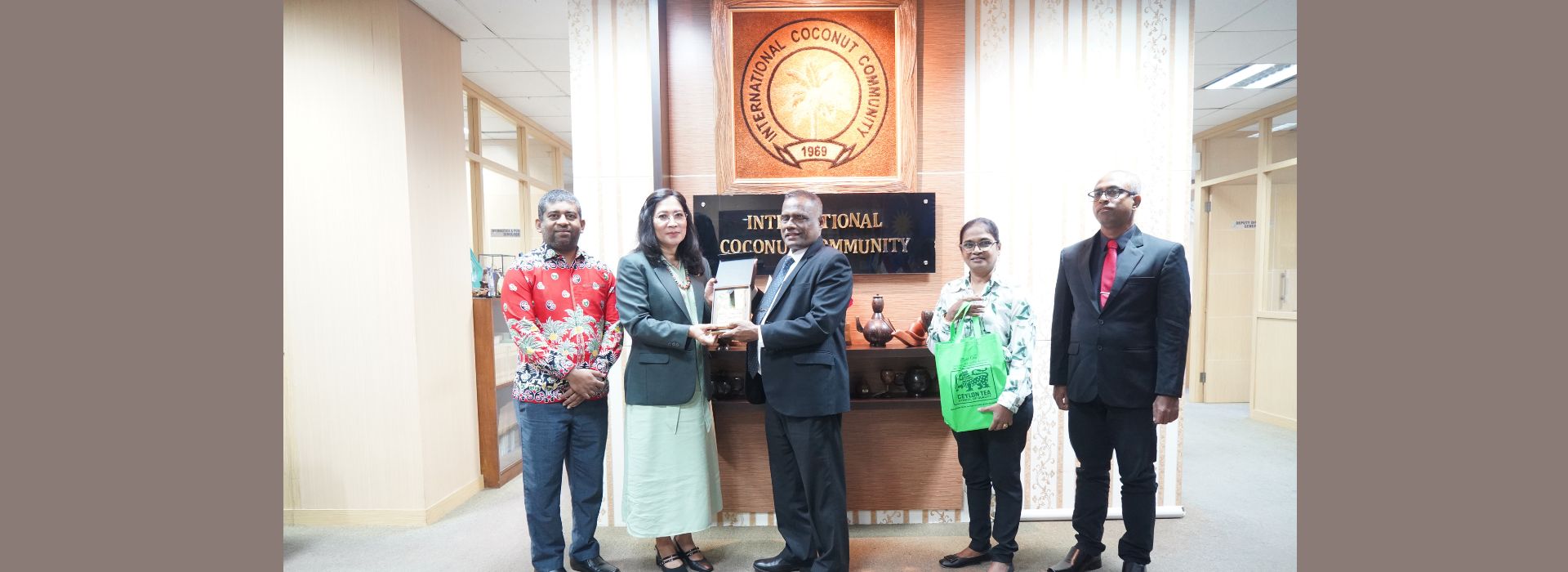
A high-level delegation from Sri Lanka undertook a Foreign Exposure Visit to Indonesia from 08 to 14 February 2026 with the objective of strengthening cooperation and enhancing knowledge exchange on coconut sector development, trade, and logistics. The visit was organized following a formal request from the Ministry of Plantation and Community Infrastructure and the Coconut Development Authority (CDA) of Sri Lanka and was facilitated by the Secretariat of the International Coconut Community (ICC). The Sri Lankan delegation was led by Mr. Shantha Ranathunga, Chairman of CDA, and comprised senior officials from key stakeholder institutions, including the Ministry of Plantation and Community Infrastructure, Coconut Development Authority, Coconut Research Institute (CRI), and the National Plant Quarantine Service. In addition to broader capacity-building objectives, a key focus of the exposure programme was to assess the feasibility of importing dehusked coconuts (with shell) and dried coconut chips from Indonesia, particularly to address seasonal raw material shortages faced by Sri Lanka’s coconut processing industry. This demand is a positive indicator for the coconut market and a strategic tool to support farmer livelihoods when domestic supply exceeds local industrial absorption.
Institutional Engagements in Jakarta (9–10 February 2026)

The programme commenced with a series of institutional meetings in Jakarta on 9–10 February 2026, focusing on regulatory, trade, and standards frameworks relevant to the coconut sector.
The delegation first visited the Indonesian Quarantine Agency, where discussions centered on biosecurity, phytosanitary certification, pest risk management, and traceability systems essential for international trade in coconut and coconut-based products. These discussions were particularly relevant to the delegation’s interest in understanding the regulatory and scientific requirements associated with the potential importation of dehusked coconuts and dried coconut chips.

Subsequently, meetings were held at the Ministry of Trade, where Indonesian officials highlighted the significance of the coconut sector to the national economy, its wide geographic spread across Indonesia, and the country’s export-oriented coconut value chains. Indonesian officials highlighted the significance of the coconut sector and the "national spirit" of downstreaming. Central to this is the Coconut Downstreaming Roadmap 2025–2045 released by BAPPENAS, which designates coconut as a National Strategic Project. Discussions also covered trade policies, downstream development strategies, and market access considerations relevant to coconut raw materials and semi-processed products.


The delegation also visited the Indonesia National Single Window (INSW), where officials explained Indonesia’s digitalized trade facilitation system that integrates multiple government agencies involved in export and import processes. The delegation learned about electronic submission procedures, inter-agency coordination, and how the system supports efficient processing of agricultural commodities, including coconut products.

On 10 February, the programme continued with a technical session at the National Standardization Agency of Indonesia (BSN). Discussions focused on the development and implementation of Indonesian National Standards (SNI), conformity assessment mechanisms, and the role of standards in ensuring product quality, competitiveness, and market access for coconut and value-added coconut products, including dried coconut products.
Field Visits in North Sulawesi and Bogor (11–14 February 2026)
On 11 February 2026, the delegation visited the Government of North Minahasa Regency, where discussions were held on the region’s strong coconut production base and expanding downstream industry. The exchanges also explored opportunities for cooperation in trade linkages, technology exchange, and value-added processing relevant to both fresh and semi-processed coconut products.
Following the official discussions, the delegation visited PT Royal Coconut, a major coconut processing company producing desiccated coconut, coconut water, virgin coconut oil, and other derivative products. The visit provided first-hand exposure to Indonesia’s industrial-scale coconut processing operations and export-oriented value chains.


On 12 February 2026, the delegation visited BRMP Palma under the Ministry of Agriculture. Indonesian experts presented an overview of the national coconut sector, ongoing research initiatives, and conservation programmes. The delegation also observed coconut genetic resources maintained at the institute, including unique varieties such as Bido coconut and Kopyor coconut. Later that day, the delegation returned to PT Royal Coconut for further observation of factory operations. On 13 February 2026, the delegation visited a coconut warehouse facility at Tanjung Priok, North Jakarta, where they observed export logistics, pre-shipment handling, cleaning, and packing of dehusked coconuts. This visit was particularly relevant to the delegation’s assessment of supply chain management, quality assurance, and export readiness for potential shipment of dehusked coconuts.
 The exposure visit concluded on 14 February 2026 with a visit to PT. House of Charcoal Indonesia in Bogor, West Java. The delegation was received by the company’s owner, Mr. Asep Jembar Mulyana, who provided a comprehensive briefing on the production of coconut shell charcoal-based shisha briquettes. The delegation observed the full production process, including carbonization, crushing, mixing, molding, drying, and packaging, as well as discussions on export marketing, quality standards, and branding strategies.
Strengthening Indonesia–Sri Lanka Cooperation
The exposure visit concluded with strong mutual interest from both sides to further enhance cooperation in coconut sector development, particularly in the areas of trade in coconut raw materials and semi-processed products, research collaboration, logistics, standards, and downstream processing. The programme is expected to contribute significantly to strengthening Indonesia–Sri Lanka collaboration and to support sustainable growth and innovation within the coconut sector across ICC member countries. By acknowledging that logistical hurdles and market fluctuations may create future surpluses, both countries recognized that Sri Lankan demand serves as a complementary market force. This partnership ensures that Indonesian farmers are protected against price volatility while simultaneously safeguarding the availability of raw materials for domestic demand and supporting the sustainable growth of the coconut sector across ICC member countries.
