
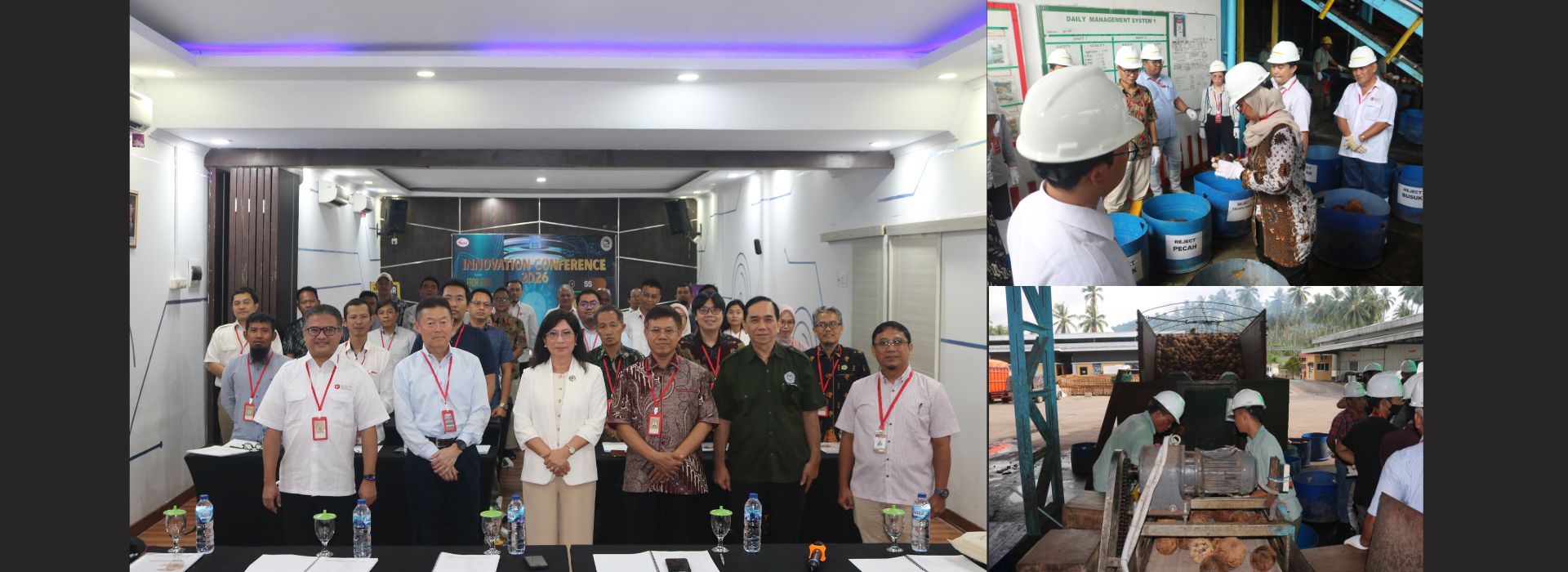
A Training of Trainers (ToT) on Manual Sorting of Non-Standard Coconuts was successfully conducted from 27–30 April 2026 at PT Sasa Inti in South Minahasa, North Sulawesi, Indonesia. This training program addresses a dual mandate: safeguarding global food security by preventing the diversion of food-grade nuts into industrial streams, and accelerating the transition toward Sustainable Aviation Fuel (FUEL) and carbon neutrality.
The training was jointly organized by the National Research and Innovation Agency (BRIN) and the International Coconut Community (ICC), with support from the Indonesia Japan Business Network (IJBNet).


The ToT program was officially opened by Dr. Jelfina C. Alouw, the Director General of the International Coconut Community (ICC), highlighting the importance of strengthening technical capacity in coconut sorting to support sustainable and traceable supply chains. Inefficient sorting poses a direct threat to food security. Without precise classification, high-quality, food-grade coconuts risk being diverted into low-value industrial applications. Conversely, the failure to valorise non-standard nuts results in lost economic opportunity for smallholder farmers, weakening the socio-economic pillars of the regional food system.
 During the opening ceremony, remarks were delivered by distinguished dignitaries, including Mr. Snowerdi Sumardi, CMO of PT Sasa Inti, Dr. Suyoto Rais, Chairman of the Indonesian Japan Business Network (IJBNet), Prof. Dr. Dedie Tooy, Dean of the Faculty of Agriculture of Sam Ratulangi University, and Mr. Motoharu Ochiai of Green Power Development, Japan. All speakers emphasized the growing importance of utilizing non-standard coconuts as feedstock for Sustainable Aviation Fuel (SAF) and the need for standardized sorting practices across the supply chain.
The four-day training brought together 25 participants representing various institutions, including PT Sasa Inti, BRIN, ICC, PT GPP, PT A3, and IJBNet. The program was facilitated by three master trainers from BRIN and ICC, who delivered both technical and practical sessions.
The ToT focused on developing participants’ competencies in identifying and sorting non-standard coconuts based on standardized criteria, as well as equipping them with the skills to conduct training for sorting operators. The training adopted a hands-on, learning-by-doing approach, with extensive practical sessions using real coconut samples and scenario-based exercises.
This initiative marks an important step toward strengthening the coconut supply chain to support emerging industries such as SAF, while ensuring compliance with sustainability and traceability requirements. Participants who successfully completed the program are expected to serve as trainers and contribute to the wider implementation of standardized coconut sorting practices in their respective organizations.
